Cloud-based Software-as-a-Service platforms have become fundamental to modern business operations. Organizations rely on SaaS applications for communication, collaboration, document sharing, customer management, and productivity. While these platforms improve efficiency and accessibility, they have also become attractive tools for cybercriminals seeking to launch sophisticated phishing campaigns.
Recent investigations and ransomware attack news reports reveal a growing trend in which threat actors abuse legitimate SaaS services to distribute malicious content, harvest credentials, and establish initial access into enterprise environments. Because these platforms are trusted by users and frequently whitelisted by security solutions, attackers can often bypass traditional defenses more effectively than with conventional phishing infrastructure.
As a result, SaaS platform abuse has emerged as a significant driver of modern phishing attack campaigns and broader cyber intrusion operations.
Why Threat Actors Are Leveraging Trusted SaaS Platforms
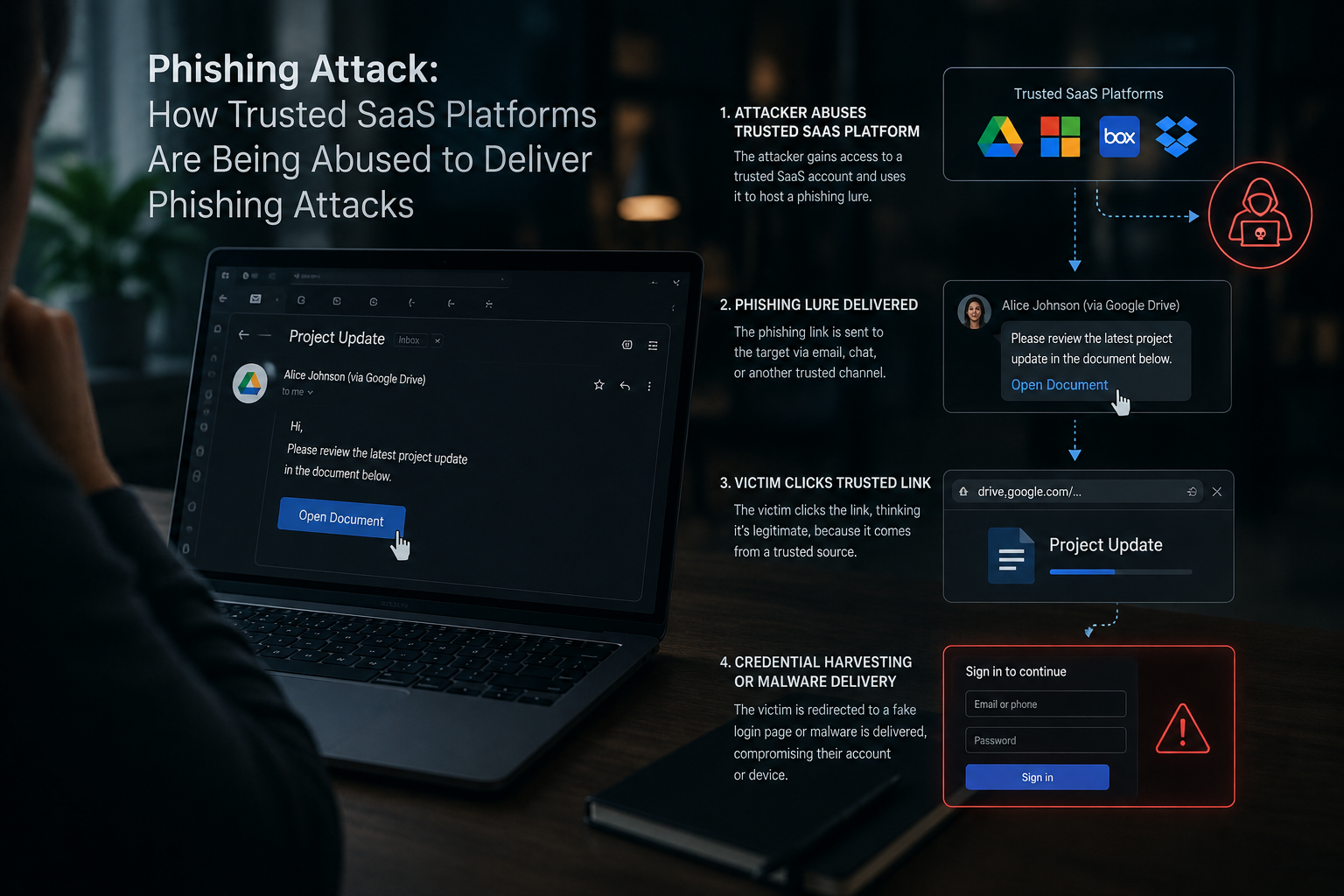
Traditional phishing campaigns often rely on newly registered domains, malicious websites, or suspicious email infrastructure that can be identified and blocked by security tools. Trusted SaaS platforms offer attackers a way to overcome these obstacles.
Threat actors commonly exploit:
Cloud file-sharing services
Business collaboration platforms
Online form builders
Project management tools
Customer relationship management systems
Cloud storage applications
Enterprise communication platforms
By hosting malicious files, fake login pages, or phishing content within legitimate services, attackers benefit from the reputation and trust associated with those platforms.
Victims are more likely to interact with links that originate from recognized providers. Additionally, many email security solutions assign lower risk scores to content delivered through established SaaS domains.
This tactic significantly increases the effectiveness of modern phishing attack operations while reducing the likelihood of immediate detection.
Common SaaS Abuse Techniques Used in Phishing Campaigns
Threat intelligence investigations have identified several methods attackers use to weaponize trusted SaaS environments.
Malicious File Sharing
Cybercriminals upload documents containing phishing links or malware and distribute them through legitimate cloud storage services.
Fake Authentication Portals
Attackers create convincing login pages hosted on trusted platforms or embedded within cloud-based applications to harvest credentials.
OAuth Application Abuse
Users may be tricked into granting permissions to malicious applications that provide attackers with access to email accounts, files, and business data.
Shared Document Lures
Victims receive notifications claiming that an important document has been shared with them. Clicking the link redirects them to credential theft pages.
Automated Notification Exploitation
Many SaaS services automatically send notifications from legitimate domains. Attackers abuse these features to increase the credibility of phishing messages.
Numerous ransomware attack news investigations have shown that attackers frequently use these techniques to gain initial access before launching larger ransomware operations.
Security Implications for Organizations
The abuse of trusted SaaS platforms creates unique challenges for enterprise security teams. Traditional defenses often focus on identifying malicious infrastructure, but legitimate cloud services blur the distinction between trusted and malicious activity.
Potential consequences include:
Credential theft
Business email compromise
Unauthorized cloud access
Data exfiltration
Privilege escalation
Ransomware deployment
Supply chain compromise
A successful phishing attack targeting cloud identities can provide access to multiple systems through single sign-on environments. Once inside, attackers may move laterally, establish persistence, and identify valuable assets.
In many ransomware incidents, initial compromise begins with a seemingly harmless interaction involving a trusted cloud service. Because users frequently engage with SaaS platforms as part of daily operations, malicious activity can remain undetected for extended periods.
The growing number of incidents featured in ransomware attack news demonstrates how SaaS abuse is becoming an increasingly important component of modern attack chains.
Threat Intelligence Insights and Detection Strategies
Threat intelligence analysts continue to observe increasing abuse of legitimate cloud services by both financially motivated cybercriminals and advanced threat groups.
Security teams should monitor for indicators such as:
Unexpected OAuth consent requests
Suspicious file-sharing activity
Unusual authentication patterns
Logins from unfamiliar locations
Abnormal cloud application usage
Unauthorized privilege grants
Unusual document access behavior
Effective detection requires visibility across cloud environments and identity systems.
SaaS Security Monitoring
Organizations should continuously monitor cloud applications for suspicious activities and unauthorized integrations.
Identity Threat Detection
Monitoring authentication events can help identify compromised accounts before attackers expand access.
User Behavior Analytics
Behavioral monitoring can reveal abnormal interactions with SaaS platforms and cloud resources.
Threat Intelligence Correlation
Combining threat intelligence with cloud telemetry enables security teams to identify emerging attack patterns more quickly.
Many modern phishing attack campaigns are specifically designed to evade conventional security controls, making proactive monitoring increasingly important.
Enterprise Defense Strategies and Future Threat Outlook
As organizations continue expanding their use of cloud-based services, attackers will likely increase their focus on trusted SaaS platforms. The effectiveness of these tactics ensures they will remain a preferred method for credential theft and initial access operations.
Organizations can strengthen defenses by:
Enforcing multi-factor authentication
Implementing Zero Trust security principles
Restricting OAuth application permissions
Monitoring cloud environments continuously
Conducting SaaS security assessments
Providing phishing awareness training
Reviewing third-party integrations regularly
Deploying advanced email security controls
Establishing cloud-focused incident response procedures
The future threat landscape will likely involve more sophisticated abuse of legitimate services, greater automation, and increased use of artificial intelligence to create convincing phishing content.
The evolving nature of cloud-based threats highlights an important reality for enterprise security teams: trusted platforms cannot automatically be trusted activity. As demonstrated by numerous ransomware attack news reports, attackers are increasingly weaponizing legitimate SaaS environments to bypass defenses and gain access to valuable assets. Organizations that improve visibility into cloud activity, strengthen identity security, and adopt proactive monitoring strategies will be better positioned to defend against the next generation of phishing attack campaigns.