
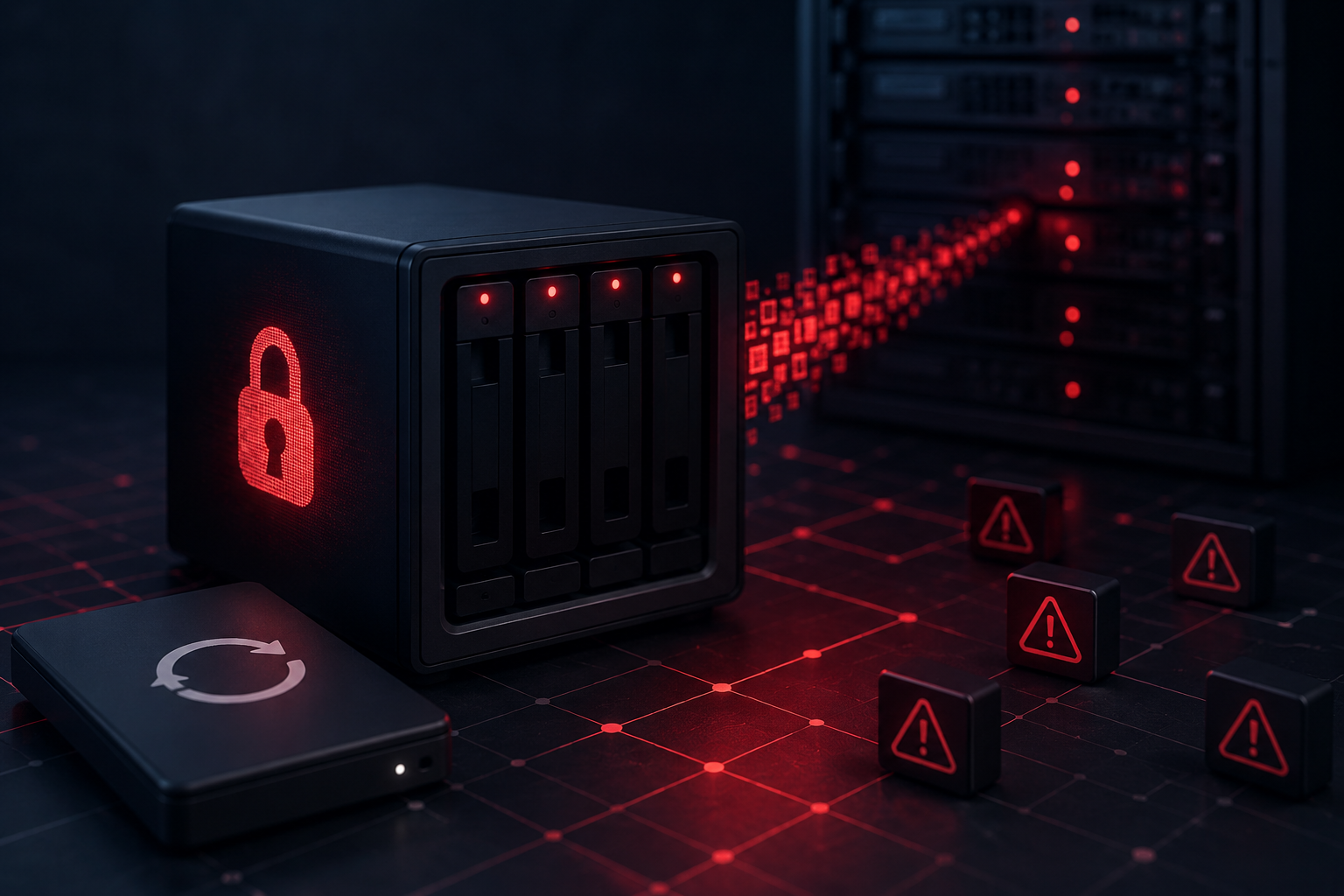
Introduction: The New Reality of Backup-Centric Attacks
Modern enterprise environments are experiencing a structural shift in adversary behavior where a ransomware breach no longer begins with encrypting production systems but with silently dismantling recovery pathways. Instead of focusing only on endpoints, attackers increasingly prioritize backup repositories, snapshot systems, and replication pipelines. This evolution reflects a broader understanding that organizations with strong data protection strategies rely heavily on backups to restore operations quickly. As a result, compromising these systems delivers higher leverage and faster ransom outcomes. This changing landscape is forcing infrastructure leaders to rethink data resilience, segmentation, and recovery-first architecture across distributed enterprise environments.
Why Backup Systems Have Become the First Line of Attack
Traditional ransomware campaigns once focused on encrypting live workloads, but modern threat actors now recognize that enterprise continuity depends on immutable backups and replicated storage tiers. In many cases, a ransomware breach is preceded by weeks of reconnaissance targeting backup credentials, API tokens, and storage orchestration layers. Once access is gained, attackers attempt to delete recovery points or corrupt snapshot chains before triggering encryption events in production systems.
Recent cybersecurity alerts from enterprise security teams indicate that adversaries are mapping backup infrastructure as carefully as production networks. This includes identifying network-attached storage, object storage repositories, and hybrid backup gateways. At the same time, phishing attack news continues to show that credential theft remains the primary entry point, enabling attackers to pivot into backup management consoles without immediate detection. The combination of identity compromise and backup exposure creates a high-impact failure scenario where recovery becomes impossible.
Backup Infrastructure as a Hidden Attack Surface in Enterprise Storage
Enterprise storage environments are increasingly complex, spanning on-premises systems, cloud buckets, and distributed replication nodes. Within this complexity lies an expanded attack surface that is often under-monitored compared to production workloads. A modern ransomware breach frequently exploits misconfigured permissions in backup APIs or unsecured administrative interfaces in storage orchestration layers.
In large-scale environments, data centralization is intended to improve efficiency, but it can also amplify risk when backup systems are tightly coupled with production authentication domains. This is where cybersecurity alerts play a crucial role in detecting unusual access patterns, such as mass deletion attempts or abnormal snapshot lifecycle modifications. Security teams also correlate signals from phishing attack news campaigns that demonstrate how attackers escalate from email compromise to storage-level access within hours.
Enterprise IT managers are now reassessing backup segmentation strategies, ensuring that backup credentials are isolated from production identity providers. This separation reduces lateral movement opportunities and limits the blast radius of a potential intrusion.
Hybrid Storage Architectures and the Emerging Resilience Gap
Hybrid storage architectures—combining on-premises infrastructure with cloud-based scaling layers—have become standard for enterprise workloads. However, this flexibility introduces a resilience gap when backup synchronization processes are not independently secured. In a modern ransomware breach, attackers often exploit synchronization channels between hybrid nodes to propagate malicious changes across environments.
The challenge becomes even more pronounced in high-availability storage systems where replication is continuous. If backup integrity validation is not enforced at each node, attackers can silently contaminate recovery copies. As cybersecurity alerts increasingly highlight, these threats are not always detected in real time due to the volume of inter-system traffic and distributed logging complexity.
Additionally, patterns observed in phishing attack news reveal that attackers increasingly target cloud administrator accounts to manipulate hybrid storage configurations. Once inside, they can disable versioning, alter retention policies, or trigger destructive replication cycles. This creates a scenario where hybrid flexibility, if not properly governed, becomes a structural weakness rather than an advantage.
Security Signals, Threat Intelligence, and Operational Awareness
Modern defense strategies rely heavily on correlating telemetry from endpoints, identity systems, and storage platforms. In this context, cybersecurity alerts act as the first layer of detection, identifying anomalies that may indicate early-stage reconnaissance or privilege escalation attempts. However, alerts alone are insufficient unless they are enriched with threat intelligence and contextual understanding of attacker behavior.
A typical ransomware breach lifecycle now includes stages that are detectable only when organizations unify logging from backup orchestration tools, identity providers, and network monitoring systems. For instance, repeated failed authentication attempts against backup APIs often precede credential reuse attacks identified in phishing attack news campaigns. By linking these signals, security operations centers can identify coordinated intrusion attempts before data loss occurs.
Advanced enterprises are also integrating AI-driven analytics to process cybersecurity alerts at scale. These systems can distinguish between routine backup maintenance activities and malicious manipulation of snapshot lifecycles. This improves response times and reduces the risk of false negatives in large distributed environments.
AI Data Workloads and the Need for Continuous Data Availability
As AI-driven applications expand across industries, data pipelines are becoming more dynamic and storage-intensive. Training datasets, vector embeddings, and inference logs must remain continuously available to avoid disrupting model performance. In this environment, a ransomware breach can have cascading effects beyond IT systems, directly impacting AI model accuracy and operational continuity.
Storage architectures supporting AI workloads require not only scalability but also rapid recovery capabilities. Any disruption in data availability can degrade model training cycles or inference pipelines. This is why cybersecurity alerts are increasingly integrated into AI infrastructure monitoring systems, ensuring that anomalies in data access patterns are flagged early.
At the same time, insights from phishing attack news continue to highlight the human factor in AI infrastructure compromise. Administrative access to AI data platforms is often targeted through social engineering, emphasizing the need for strong identity governance across both data and model layers. Without such controls, AI systems become indirect victims of infrastructure-level breaches.
Conclusion: Redefining Resilience Against Backup-First Ransomware
The evolution of attack strategies shows that a ransomware breach is no longer a single-layer encryption event but a coordinated effort to dismantle recovery ecosystems before triggering disruption. Enterprises must shift their focus from reactive recovery to proactive isolation of backup infrastructure, ensuring that storage systems are resilient by design rather than by assumption. By integrating continuous monitoring, identity segmentation, and intelligent alerting systems, organizations can reduce exposure to advanced intrusion pathways. Ultimately, strengthening backup integrity and aligning security operations with real-time intelligence remains essential for sustaining long-term data resilience in modern enterprise environments.